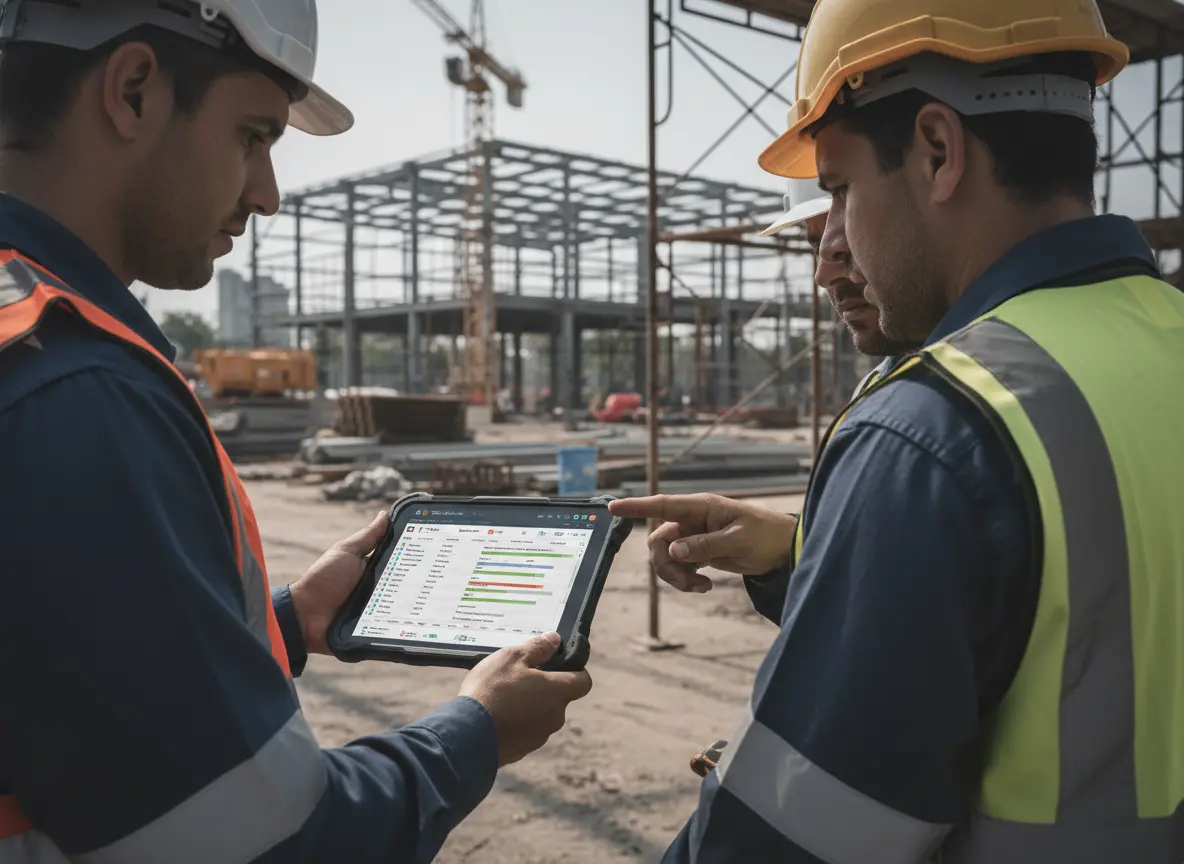
Contractors and service teams need more than a basic task app. When jobs, schedules, customer updates, invoices, and crew assignments are spread across different tools, work slows down and details get missed.
The best work management software for contractors keeps job tracking, task ownership, scheduling, customer communication, and billing connected in one system. This helps office teams and field crews stay aligned without chasing updates through texts, spreadsheets, calls, and separate apps.
Quick Answer
What is the best work management software for contractors?
The best work management software for contractors connects jobs, tasks, schedules, customer records, field updates, files, and billing in one system. Contractors should prioritize clear task ownership, mobile access, scheduling visibility, job tracking, customer context, and simple workflows that office staff and field crews can use consistently.
Work Management Solutions Comparison Table
Not every work management solution fits contractor workflows. Some tools are fine for simple task lists, but service teams usually need job records, scheduling, customer notes, field updates, and billing connected. Use this table to compare which system type fits your team best.
| Work Management Solution Type | Best For | Main Benefit | Limitation |
|---|---|---|---|
| All-in-one work management platform | Contractors and small service teams | Connects jobs, tasks, schedules, customer details, and updates in one place | Requires team adoption |
| Basic task management app | Small internal teams with simple to-do lists | Easy task tracking | Usually lacks job records, scheduling, CRM, and billing connections |
| Spreadsheet-based tracking | Very small teams starting out | Low cost and flexible | Easy to break, hard to scale, and requires manual updates |
| Project management software | Office teams managing projects and timelines | Strong for project timelines and collaboration | May not fit field service workflows |
| Calendar-based scheduling tool | Teams focused mainly on appointments | Helps organize dates and availability | Does not manage full job progress by itself |
| CRM with task features | Sales and customer follow-up teams | Keeps customer records and follow-ups organized | May not fully manage field work or job operations |
Admin Tasks Contractors Can Automate With Work Management Software
Contractors lose time when office staff and field crews have to manually update the same information across schedules, customer records, job notes, invoices, and messages. Work management software helps reduce this admin load by connecting the most common daily tasks in one system.
| Admin Task | How Software Helps | Business Benefit |
|---|---|---|
| Job scheduling | Creates and updates schedules from one shared calendar | Reduces double booking and last-minute confusion |
| Task assignment | Assigns work to specific team members with due dates | Improves accountability and ownership |
| Customer follow-ups | Tracks calls, messages, estimates, and next steps | Helps prevent leads and clients from being forgotten |
| Job status updates | Lets field teams update progress from the job site | Reduces calls between the office and crews |
| Invoicing | Connects completed work with billing details | Helps invoices go out faster and more accurately |
| File and note tracking | Stores job notes, documents, photos, and updates in one place | Reduces time wasted searching for information |
How to Choose the Right Work Management Solution
Choosing the right work management solution starts with understanding how your team actually works. The goal is not to add another tool. The goal is to reduce confusion, improve visibility, and help people finish work with fewer delays.
Use these questions before choosing a platform:
| Question | Why It Matters |
|---|---|
| Does it show task ownership clearly? | Teams need to know who is responsible for each step. |
| Can it track job progress? | Managers need visibility before work falls behind. |
| Does it support schedules and deadlines? | Work management should help teams stay on time. |
| Can files and notes stay connected to the work? | Scattered documents slow teams down. |
| Is it easy for employees to update? | Complicated systems reduce adoption. |
| Can it support growing workflows? | The system should still work as jobs, users, and responsibilities increase. |
| Does it connect with customer and scheduling needs? | Teams work better when tasks, schedules, and customer records stay connected. |
The right work management solution should make daily work easier to see, easier to assign, and easier to complete.
Best Work Management Software Features for Contractors
The best work management software for contractors should support the daily workflow between office staff, field crews, managers, and customers. A simple task list is not enough when jobs involve schedules, estimates, job notes, materials, customer updates, and invoices.
Key features to look for include:
- Job tracking with clear status updates
- Task assignments with owners and due dates
- Crew scheduling and calendar visibility
- Customer records connected to active jobs
- File, note, and photo storage
- Mobile access for field teams
- Automated follow-ups and reminders
- Invoicing connected to completed work
- Real-time dashboards for managers
If a tool only tracks tasks but does not connect jobs, schedules, customers, and billing, it may create more admin work as the business grows.
What a Work Management Solution Does for Growing Teams
A work management solution is a system that helps teams organize tasks, track progress, manage communication, and coordinate work in one place. It replaces disconnected tools with a centralized platform where all work stays visible and aligned.
For growing teams, this means fewer missed deadlines, clear task ownership, and faster decision-making. Everyone sees what needs to be done, who owns it, and how work is progressing in real time.
The operational cost of not having this is higher than most business owners realize. According to Asana’s research, knowledge workers spend 60% of their workday on what they call “work about work” chasing status updates, attending unnecessary meetings, switching between tools, and re-explaining context that should already be in the system. That is more than half of every paid hour going toward coordination overhead rather than actual output.
When work is managed in one system, operations run more efficiently. Teams spend less time switching between apps and more time completing tasks, which improves productivity and supports long-term growth.
Work Management Software vs Basic Task Apps
Basic task apps help teams list work, but they usually stop there. Contractors need more than a checklist. They need job details, crew assignments, schedules, client notes, invoices, and field updates connected in one place.
A task app may help you remember what needs to happen. Work management software helps you control the full job from request to completion. For contractors, that difference matters because missed updates, delayed invoices, and unclear ownership directly affect revenue.
Use MBP when you need your CRM, scheduling, work orders, and invoicing to work together instead of forcing your team to copy the same information across different tools.
Why Contractors Need Work Management Software
Manual tracking breaks down fast when your business grows.
You start dealing with:
- Missed job updates
- Confused technicians
- Delayed work orders
- Lack of visibility from the office
Work management software gives you:
- Real-time job tracking
- Clear task assignments
- Better coordination between office and field
- Fewer delays and mistakes
For contractors, work management software is not only about staying organized. It helps prevent lost job details, missed customer updates, delayed invoices, and field mistakes that reduce profit.
For teams that also need customer tracking, connect this with contractor CRM software and job scheduling software for contractors.
| Contractor Problem | Why It Hurts Productivity | What Work Management Software Fixes |
|---|---|---|
| Jobs tracked in spreadsheets | Updates become outdated fast | Centralized job tracking |
| Crew assignments sent by text | Details get missed or buried | Clear task ownership |
| Schedule changes handled manually | Teams show up late or unprepared | Connected calendar updates |
| Customer notes stored separately | Office and field teams lose context | CRM-connected job records |
| Completed work not tied to billing | Revenue can be delayed or missed | Job-to-invoice workflow |
| Managers chase updates all day | Time gets wasted on admin | Real-time job visibility |
Why Disconnected Tools Slow Team Performance
The problem is not that your team lacks effort. The problem is structural.
Disconnected tools increase coordination work because employees must repeatedly switch systems, search for information, transfer updates manually, and confirm which version of the data is current. As the number of jobs, employees, and customer requests grows, that administrative friction becomes harder to manage.
Here is what that fragmentation costs in practice:
Time lost to coordination. When tasks live in one app, updates in another, and scheduling in a third, information does not flow automatically. Someone has to chase it. That person is usually you or your team lead, spending time on administration instead of delivery. One study found that 50% of teams spend at least one full day every month doing nothing but manually pulling together project status updates.
Ownership gaps. Verbal assignments and scattered messages create accountability vacuums. When there is no central record of who owns what and when it is due, work falls through the cracks not because anyone is irresponsible, but because the system does not enforce it.
Decisions made on stale data. When managers have to compile reports manually instead of reading live dashboards, they are always working with yesterday’s picture. By the time a problem shows up in a status meeting, it has already cost you time you cannot recover.
The fix is not adding another app to the stack. It is replacing the stack with a single system where all of these functions run together.
What Makes a Work Management System Effective
Not every platform that calls itself a work management solution delivers the same results. The difference between a tool that gets used and one that gets abandoned usually comes down to a few core qualities.
Reduce Friction Instead of Adding More Work
The point of a work management solution is to make running your team easier. If the platform requires constant manual updates, complicated setup, or forces your team to switch between multiple apps just to complete basic tasks, it is adding friction rather than removing it. The best solutions feel like a natural extension of how your team already works.
Adoption is the real test. A platform that requires extensive configuration before your team sees any value will be abandoned within weeks. Look for systems where basic use, assigning tasks, checking progress, sending updates is immediately intuitive without training.
Centralization Keeps Work Aligned
Scattered tools create scattered teams. When tasks live in one app, communication in another, scheduling in a third, and invoicing somewhere else entirely, nothing stays in sync. A true work management solution brings those functions together so that information flows automatically between them without anyone having to chase it down.
The business case for this is straightforward: when every function runs on the same data, errors from manual re-entry disappear, handoffs happen automatically, and there is always one version of the truth for everyone to work from.
Real-Time Visibility Improves Decisions
When every team member, project, and deadline is visible in one place, managers stop reacting and start leading. Real-time visibility lets you spot bottlenecks before they become missed deadlines, reassign work before it piles up, and report on progress without building reports manually.
This matters more at scale. A five-person team can coordinate informally. A fifteen-person team with three job sites running simultaneously cannot. The operational gap between what is happening in the field and what leadership sees in the office is where costly mistakes happen.
Practical Automation Saves Time
Workflow automation is only valuable if it handles the tasks your team actually repeats. Routine follow-ups, recurring assignments, status updates, and scheduling reminders are the kinds of tasks that drain time without adding value. A good work management solution automates these consistently so your team’s attention stays on work that matters.
The target is eliminating the administrative drag that builds up at every handoff point in your operation. Every time a completed task requires someone to manually notify the next person, update a log, or transfer data into another system, you are paying for labor that should not exist.
Choose a System That Scales With Growth
A platform that works for a five-person team but breaks down at twenty is not a long-term solution. Look for systems that scale without requiring you to rebuild your entire workflow every time your operation expands. The cost of migrating to a new platform mid-growth, in time, training, and lost productivity is far higher than choosing the right system from the start.
What contractors specifically need from a work management platform
- Job-level visibility. Every active job should show its current status, assigned technician, scheduled time, and progress against scope, visible to office staff and field teams simultaneously. Contractors can also use work order management tools to track tasks, job progress, team updates, and completed work from one place.
- Dispatch and scheduling in the same system as the job record. Separate scheduling tools require manual data transfer at every handoff. When dispatch and job management are unified, schedule changes update the job automatically.
- Direct connection between completed work and invoicing. The moment a job closes, the invoice should be ready to send. Any manual step between job completion and invoice generation is a potential leak point.
- Mobile access for field teams. Field technicians should be able to update job status, log materials, and capture signatures in real time from a mobile device, not reconstruct the day’s work from memory at the end of a shift.
- Client communication managed from within the job record. When client messages and updates are attached to the job rather than living in a separate email thread, nothing falls out of context.
MyBusinessPortal.Cloud is built specifically to meet these requirements for electricians, plumbers, HVAC companies, installation teams, and other field service businesses across the United States. The platform connects CRM, job management, scheduling, dispatch, invoicing, and team communication in one system, designed for the operational reality of service businesses where the gap between the field and the office is where revenue disappears.
Contractors that need better job visibility can use work management software to organize tasks, crew updates, job progress, and completed work in one place.
Teams that also manage appointments and dispatch can connect this with contractor scheduling software so job changes, crew availability, and deadlines stay easier to track.
For lead follow-ups and customer communication, MBP also connects with contractor CRM software so client details stay attached to the work.
How Work Management Integration Connects Jobs and Billing
Most teams don’t have a work management problem. They have an integration problem.
Tasks live in one tool. Schedules in another. Invoices somewhere else. And between each of those systems, someone has to manually move information from one place to the next. That’s where things get missed.
A job gets updated in the field but the office doesn’t see it. A schedule changes but the job record doesn’t reflect it. Work gets completed but the invoice sits in a queue until someone remembers to send it. None of this happens because your team isn’t trying. It happens because the tools don’t talk to each other.
Work management integration fixes this by putting jobs, scheduling, and invoicing in one place. When a technician updates a job, the schedule updates automatically. When a job closes, the invoice is ready to go. No one has to transfer data between systems or chase down what happened on a job from last week.
For contractors and field service teams, this matters directly to your bottom line. Work that gets completed but never invoiced is revenue you earned and never collected. It doesn’t show up as a mistake. It just disappears.
MyBusinessPortal.Cloud connects job management, scheduling, dispatch, CRM, and invoicing in one platform. Everything runs on the same data, so when work moves forward, billing moves with it automatically. No third-party connectors. No manual steps. Nothing falling through the cracks between systems.
Work Management Solutions for Complex Teams
As teams grow, simple task trackers stop working. The failure mode is always the same: the tool was designed for one team’s needs, and it did not anticipate the coordination overhead that comes with multiple departments, overlapping projects, and distributed responsibility.
Enterprise work management solutions solve for this by centralizing tasks, approvals, communication, reporting, and cross-department workflows in one connected system. Instead of relying on separate apps for projects, updates, scheduling, and accountability, enterprise-level platforms create a centralized structure that keeps everyone aligned.
The cost of not having this alignment grows with team size. Duplicated work, unclear ownership, and missed deadlines that cost hours at ten people cost days at fifty. The bigger the operation, the more expensive operational chaos becomes.
What enterprise work management requires that basic tools cannot provide:
- Cross-team visibility. Leadership needs a real-time view of work across all departments and projects, not just within a single team’s task list.
- Approval workflows. Work that requires sign-off before proceeding needs a system that enforces that routing automatically, not a verbal process that gets bypassed under deadline pressure.
- Scalable reporting. As operations grow, status should require less time to compile, not more. Enterprise platforms replace manual reporting with live dashboards that update automatically.
- Workflow customization. Different teams have different processes. A platform that forces everyone into a single workflow structure will be worked around rather than adopted.
The best enterprise work management solution is not the one with the most features. It is the one that gives leadership real-time visibility, reduces manual coordination, and scales without requiring a complete workflow rebuild at each growth stage.
Common Work Management Problems and Fixes
| Symptom | Likely Cause | Fix |
|---|---|---|
| Team misses deadlines consistently | No centralized task visibility or ownership assignment | Use a work management platform where every task has an assigned owner and due date visible to the whole team |
| Staff unsure who is responsible for which tasks | Tasks assigned verbally or through scattered messages | Log all assignments in a central system with clear ownership, priority, and deadline attached |
| Managers spend hours chasing status updates | No real-time project visibility across the team | Switch to a platform with live dashboards so status is visible without manual check-ins |
| New tools adopted but team stops using them quickly | Platform adds friction rather than removing it | Audit whether the tool requires more steps than the old process; replace with a system that fits existing workflow |
| Invoicing and project tracking fall out of sync | Billing and work management handled in separate apps | Use an all-in-one platform that connects job progress directly to invoicing without manual data transfer |
| Completed field work goes unbilled | No automated connection between job closure and invoice generation | Implement a field service platform where invoice generation triggers automatically at job completion |
| Recurring tasks get forgotten during busy periods | No automation for routine assignments and reminders | Set up workflow automation to trigger recurring tasks, follow-up reminders, and status updates automatically |
| Business outgrows the current tool as the team scales | Platform built for small teams with no scaling capacity | Choose a solution designed to grow with the operation without requiring a full workflow rebuild at each growth stage |
Who Should Use Contractor Work Management Software?
Contractor work management software is best for service businesses that handle multiple jobs, field teams, client requests, and billing steps every week.
It is especially useful for:
- Electricians
- HVAC companies
- Plumbing companies
- Installation teams
- Maintenance teams
- General service contractors
If your team relies on texts, spreadsheets, phone calls, and separate invoicing tools, MBP helps bring those steps into one system.
Choose a Work Management System Built to Scale
The gap between a team that scrapes by and a team that scales is almost always operational, not motivational. Your people are not the problem. The system is.
For most growing teams, the first step is consolidation: getting tasks, schedules, client data, and billing onto one platform where information flows automatically instead of being manually transferred. The second step is connecting that system directly to revenue so that completed work creates invoices without friction, and nothing that was earned goes uncollected.
Want to see if MBP fits your team and budget? Review our pricing or schedule a free demo.
MyBusinessPortal.Cloud brings work management, CRM, scheduling, invoicing, and HR into one connected environment built specifically for contractors and service businesses. Stop patching together disconnected apps. Start running a system that works as one.
Work Smarter With MBP
Manage Jobs, Tasks, Schedules, and Customers in One Place
MBP helps contractors connect work management, scheduling, CRM, job updates, and billing so office staff and field crews can work from the same information.
Explore Work Management Schedule a DemoRelated Work Management Resources
Use these guides if your team is trying to reduce missed updates, scattered communication, and manual admin work:
- How Work Management Software Improves Field Team Communication
- How Work Management Software Improves Crew Accountability and Job Visibility
- How Real-Time Job Updates Keep Office and Field Teams Aligned
- The Hidden Chaos of Running Projects Without a Work Management System
Work Management Solutions FAQs
What are work management solutions?
Work management solutions are platforms that help teams plan, assign, track, and complete work in one organized system. They usually include task tracking, deadlines, team updates, files, communication, and progress visibility.
What is the best work management solution for small businesses?
The best work management solution for small businesses is one that centralizes tasks, schedules, customer details, job updates, and team responsibilities without adding extra complexity. For contractors and service businesses, MBP is a strong fit because it connects work management with scheduling and CRM.
How do work management systems improve productivity?
Work management systems improve productivity by reducing scattered communication, manual updates, missed deadlines, and unclear ownership. Teams can see what needs to be done, who owns each task, and what work is already in progress.
Do small businesses need work management software?
Small businesses need work management software when jobs, tasks, customer updates, and schedules are spread across too many tools. A connected system helps owners and managers stay organized as the team grows.
What is contractor work management software?
Contractor work management software helps service businesses manage jobs, tasks, schedules, crew updates, customer details, files, and billing from one system. It gives office teams and field crews better visibility into what needs to be done and who is responsible.
Is work management software better than spreadsheets?
Work management software is better than spreadsheets when a business needs real-time updates, task ownership, scheduling, customer records, and job tracking. Spreadsheets can work for basic lists, but they become harder to manage as teams, jobs, and responsibilities grow.
What features should contractors look for in work management software?
Contractors should look for job tracking, task assignments, crew scheduling, mobile access, customer records, file storage, real-time updates, automation, and invoicing connections. These features help reduce missed details and manual admin work.
How does work management software help field teams?
Work management software helps field teams see job details, assigned tasks, schedules, customer notes, and status updates from one place. This reduces back-and-forth calls and helps crews complete work with clearer instructions.
When should a small business switch to work management software?
A small business should switch to work management software when spreadsheets, emails, texts, and separate apps are causing missed deadlines, unclear ownership, delayed updates, or billing mistakes.