

If you run a contracting business, you already know the feeling. A new job comes in, and before a single person sets foot on a job site, that job’s information has been typed, retyped, copied, pasted, and manually transferred across more systems than it should ever need to touch.
The client’s name and contact details go into your estimate. Then into your contract. Using CRM software helps contractors maintain customer information without rebuilding records across multiple systems.
Then into your invoicing software. Then into your scheduling tool. Then someone texts the crew the address separately because the scheduling tool doesn’t talk to the field team’s phones. Then the hours worked get logged on a timesheet, and someone re-enters those hours into payroll. Then the materials used get written on a clipboard, and someone transcribes those into an inventory sheet, and eventually into a final invoice that has to be cross-checked against the original estimate to make sure nothing was missed.
By the time a single job is fully closed out, the same core information has been entered by hand five, six, sometimes eight times by different people across different tools. And every one of those re-entries is a place where time gets wasted and errors get introduced.
This is one of the most pervasive and underestimated inefficiencies in the contracting industry. And for most businesses still running on a patchwork of disconnected tools, it’s happening every single day.
Quick Answer
Why do contractors waste time re-entering the same data?
Contractors waste time re-entering the same data because estimates, scheduling, payroll, invoicing, CRM, and field communication often operate in disconnected systems.
An integrated contractor management system allows job information to flow between workflows automatically, reducing duplicate entry, administrative delays, and costly mistakes.
Why Contractors Keep Re-Entering the Same Job Data
The root cause of chronic data re-entry isn’t carelessness or bad process design. It’s that most contracting businesses have assembled their tech stack one tool at a time, solving individual problems as they came up without a plan for how those tools would work together.
You needed to send estimates, so you found an estimating tool. You needed to manage schedules, so you added a scheduling app. You needed to track time, so you added a timesheet solution. You needed to invoice, so you started using an accounting platform. Each tool solved its specific problem reasonably well, but none of them were designed to talk to each other.
The result is a stack of useful but isolated systems with gaps between them, and those gaps get filled by people manually moving data from one place to another. The information exists. It just doesn’t flow.
A connected Work Management system helps contractors keep job details, tasks, updates, and completion records organized in one workflow.
How Contractor Software Eliminates Duplicate Data Entry
Contractors do not lose time because they lack information. They lose time because the same information has to be entered repeatedly across disconnected systems.
Integrated contractor software reduces duplicate work by connecting important business processes together.
Instead of manually moving information between platforms, teams can:
- Create customer records once and reuse them across workflows
- Connect estimates directly to job schedules
- Transfer completed work details into invoices
- Sync employee hours with payroll processes
- Keep field updates available for office teams
This creates a smoother workflow where information moves with the job instead of requiring employees to manually carry it between systems.
How Contractor Software Eliminates Duplicate Data Entry
Contractors do not lose time because they lack information. They lose time because the same information has to be entered repeatedly across disconnected systems.
Integrated contractor software reduces duplicate work by connecting important business processes together.
Instead of manually moving information between platforms, teams can:
- Create customer records once and reuse them across workflows
- Connect estimates directly to job schedules
- Transfer completed work details into invoices
- Sync employee hours with payroll processes
- Keep field updates available for office teams
This creates a smoother workflow where information moves with the job instead of requiring employees to manually carry it between systems.
The Hidden Cost of Manual Data Re-Entry for Contractors

Data re-entry feels like a minor annoyance. In practice, it’s an ongoing operational tax that most contracting businesses have simply stopped noticing because it’s been there so long.
How Duplicate Data Entry Wastes Administrative Time
For a contracting business running five to ten active jobs, the time spent manually transferring information between systems, estimates to contracts, contracts to schedules, timesheets to payroll, field notes to invoices easily adds up to several hours of administrative labor per week. That’s time that comes directly out of capacity for billable work, business development, or anything else that actually moves the business forward.
Why Manual Data Transfers Create Expensive Mistakes
When a human being manually transfers data from one system to another, mistakes happen. A transposed digit in an address. An incorrect hourly rate copied from an outdated estimate. A material quantity that gets rounded the wrong way. Individually, these errors seem small. Collectively, across dozens of jobs and hundreds of re-entry events over the course of a year, they add up to real money lost and real time spent on corrections.
How Small Data Errors Turn Into Bigger Operational Problems
A billing error caught before an invoice goes out is an inconvenience. A billing error caught after a client has already paid or disputed is a significantly more expensive problem involving back-and-forth communication, revised invoices, potential relationship damage, and in some cases, legal or contractual complications. The further downstream an error travels before it’s caught, the more it costs to correct.
Why Manual Processes Delay Contractor Cash Flow
In contracting, cash flow is everything. When invoicing depends on someone manually reconciling field timesheets, materials logs, and the original estimate before a bill can go out, the billing cycle stretches. Jobs that could be invoiced the day they close instead sit in an administrative queue for days. For businesses running on tight margins, that delay has a real cost.
The Business Impact of Duplicate Job Data Entry
| Manual Data Problem | Business Impact |
|---|---|
| Entering customer details multiple times | More admin hours and higher error risk |
| Manual scheduling updates | More missed information and delays |
| Copying hours into payroll | Slower payroll processing |
| Rebuilding invoices manually | Delayed billing and cash flow issues |
| Separate field and office systems | Poor communication and visibility |
Where Contractors Waste the Most Time Re-Entering Information
Not all data re-entry is created equal. Some of it is merely annoying. Some of it is genuinely costly. Here are the points in the contracting workflow where re-entry causes the most damage:
Why Estimates and Contracts Often Create Duplicate Work
Once a client approves an estimate, that information needs to live in a contract. In most businesses, this means someone either rewrites the scope and pricing manually or copy-pastes from one document to another, introducing the risk of discrepancies between what was estimated and what was contracted.
How Scheduling Systems Create More Manual Admin Work
Job details, addresses, scope descriptions, and client contact information all need to make their way into the scheduling system so the right crew gets dispatched to the right place with the right information. In a disconnected environment, this is another manual transfer.
Why Field Teams Miss Information in Disconnected Systems
Even when a job is properly scheduled, getting the relevant details to the crew in the field often involves a separate step: a text message, a printed sheet, a phone call, or a WhatsApp photo of a handwritten note. Information that should flow automatically requires human intervention to bridge the gap.
Why Manual Time Tracking Slows Payroll Processing
Hours worked in the field need to become payroll entries. When timesheets are paper-based or stored in a system that doesn’t connect to payroll, someone has to manually transfer those hours, check them against schedules, calculate overtime, and enter everything into the payroll platform. This is one of the most labor-intensive re-entry points in the entire workflow.
How Manual Job Cost Tracking Delays Invoicing
Accurately capturing what was used on a job and turning that into a billable invoice requires reconciling field records with inventory and the original estimate. When those records live in different places, this reconciliation step is manual, slow, and error-prone.
Why Accounting Workflows Break Without Integration
Even after an invoice is generated, the financial data often needs to be re-entered or manually exported into an accounting system for bookkeeping and reporting purposes.
Connecting billing information with Accounting software helps contractors reduce invoice delays and improve financial visibility.
Why Administrative Chaos Grows Faster Than Your Business
For a solo contractor or a very small crew, the re-entry burden is manageable, if annoying. But as a contracting business grows, the problem scales faster than the team does.
Adding more jobs doesn’t just add more revenue. It adds more re-entry events, more opportunities for error, more administrative hours, and more coordination complexity. Many contracting businesses hit a growth ceiling not because they lack the work or the skilled labor, but because their administrative infrastructure can’t scale cleanly without adding significant overhead. The business gets busier, the office gets more chaotic, mistakes start slipping through, and the owner ends up spending more time on administrative firefighting than on running the business.
This is the moment when the true cost of disconnected tools becomes impossible to ignore. And it’s exactly the moment when the right integrated platform delivers the most value.
How Integrated Systems Eliminate Duplicate Data Entry
When your business tools are genuinely integrated, data entered once flows automatically to wherever it needs to go. A job created in your system carries its client details, scope, address, and billing information through every subsequent stage without anyone retyping a single field. Time logged in the field flows directly into payroll calculations. Materials recorded on a work order flow directly into the invoice. Completed jobs trigger billing workflows automatically rather than waiting for someone to notice the job is done and start the process manually.
The effect on administrative workload is dramatic. Tasks that used to take hours take minutes. Errors that used to slip through get caught by the system before they become problems. Cash cycles shorten because invoicing no longer depends on a manual reconciliation process. And the people who used to spend their days moving data between systems can redirect that time toward work that actually creates value.
How MBP Connects CRM, Scheduling, Payroll, and Workflows
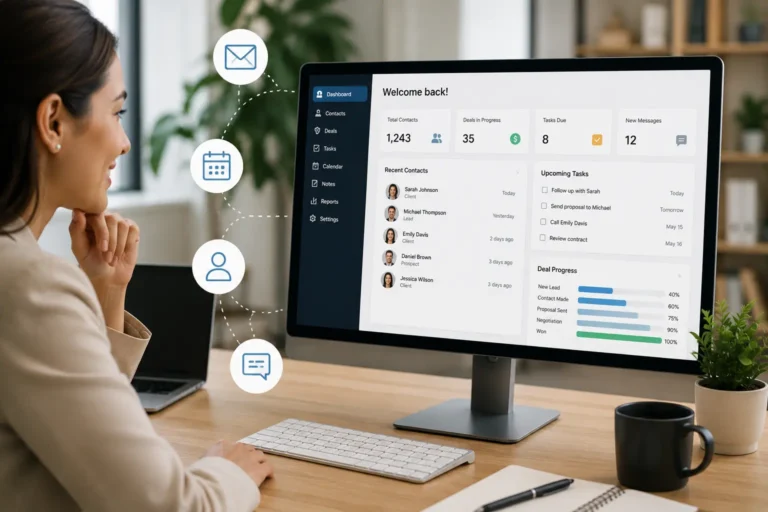
MyBusinessPortal.cloud is built around the idea that business data should flow, not get carried. Our platform brings together the tools contracting businesses rely on every day, CRM for managing leads and client relationships, work management for tracking jobs and tasks from estimate through close-out, HR for employee records and onboarding, calendar and scheduling for dispatching crews and managing timelines, and time tracking that connects directly to your payroll workflow all in one connected environment.
With connected workflows, contractors can reduce administrative repetition and create a single source of truth for customer details, job information, employee records, schedules, and billing data.
This helps teams spend less time managing information and more time completing profitable work.
When a new job is created in MBP, the client information, scope, and job details are available across every module without re-entry. When a crew member logs hours in the field, those hours are immediately visible to the back office. When a job is marked complete, the billing workflow can begin immediately with all the information already in place.
You stop paying the re-entry tax. Your data becomes reliable because it’s entered once and maintained in one place. And your team stops wasting time on the administrative friction that silently drains productivity from contracting businesses every single day.
Stop Losing Time to Duplicate Data Entry
MBP connects CRM, Work Management, Calendar, HR, and Accounting tools so contractors can manage jobs without repeatedly entering the same information.
Schedule a DemoContractor Data Entry and Workflow FAQs
Why do contractors waste time re-entering the same information?
Contractors waste time re-entering the same information because most business tools operate separately instead of sharing data automatically. Job details get copied between CRM systems, scheduling software, payroll tools, invoices, and field communication platforms multiple times throughout a project. This repetitive process creates administrative delays and increases the chance of mistakes.
What causes duplicate data entry in contracting businesses?
Duplicate data entry usually happens when businesses build their software stack one tool at a time without integration. Estimating software, scheduling apps, payroll systems, and accounting platforms often work independently instead of communicating with each other. Employees become responsible for manually moving information between systems.
Why is manual data re-entry expensive?
Manual data re-entry consumes hours of administrative work every week and creates opportunities for costly errors. Small mistakes like incorrect addresses, labor rates, or material quantities can create billing issues, scheduling problems, and customer disputes. Over time, these repeated inefficiencies quietly reduce profitability.
How does disconnected software slow down contractors?
Disconnected software slows contractors down because information has to be transferred manually between systems. Teams spend extra time updating schedules, entering payroll data, reconciling invoices, and sharing job details with field crews. Instead of work flowing automatically, employees spend valuable time handling repetitive admin tasks.
How does integrated software reduce contractor admin work?
Integrated software reduces contractor admin work by allowing job details, customer information, employee hours, and billing records to move between connected workflows without repeated manual entry.
What is the biggest problem with disconnected contractor software?
The biggest problem with disconnected contractor software is that employees must manually transfer information between systems, increasing administrative work and creating more opportunities for mistakes.
Can contractor management software improve productivity?
Yes. Contractor management software improves productivity by reducing repetitive administrative tasks, improving visibility, and allowing teams to focus more time on completing jobs.