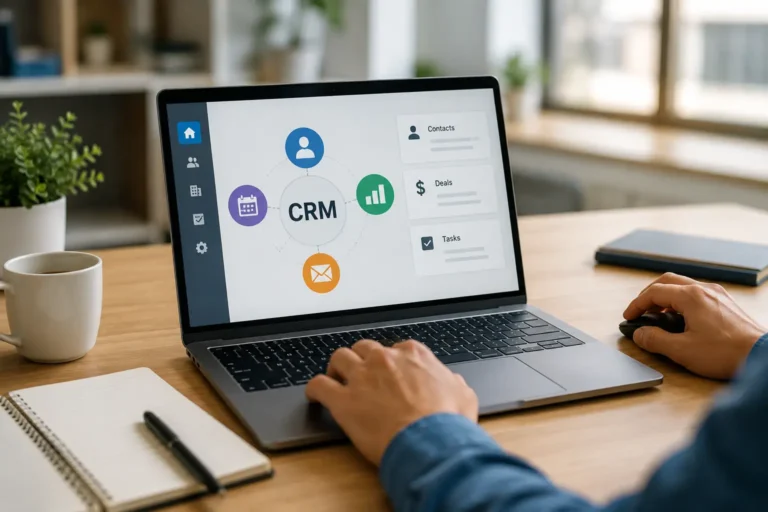

A CRM should help your team manage customers, leads, follow-ups, and sales activity. It should make work easier.
But many teams avoid using a CRM because it feels like extra admin work.
Instead of helping employees move faster, the system becomes another task on their list. They finish a call, update a spreadsheet, reply to a customer, check a schedule, then log the same details again inside the CRM.
That is when adoption drops.
When a CRM feels like punishment, your team will avoid it, delay updates, or enter the bare minimum just to get through the day.
Quick Answer
Why do teams avoid CRM software that feels like admin work?
Teams avoid CRM software when it creates extra data entry, duplicate updates, complicated workflows, and more administrative tasks instead of helping employees work faster.
A team-friendly CRM improves adoption by connecting customer details, follow-ups, tasks, and schedules in one simple system.
CRM Adoption Problems and Fixes
| CRM Adoption Problem | Why Teams Avoid It | How to Fix It |
|---|---|---|
| Too much manual data entry | Employees feel like CRM updates slow down real customer work. | Reduce required fields and only track information that supports sales, follow-ups, and service. |
| Duplicate updates | Teams enter the same notes in emails, spreadsheets, calendars, and the CRM. | Connect CRM with scheduling and work management so updates live in one system. |
| Unclear value for users | Employees see the CRM as a reporting tool for managers. | Make the CRM useful for daily work by showing follow-ups, customer history, lead status, and next steps. |
| Complicated workflows | Too many stages, clicks, or approval steps make the CRM feel heavy. | Use simple workflows that match how the team already handles leads, quotes, and customers. |
| Poor training | Staff use the CRM differently or avoid it because they are unsure what to update. | Train the team on what to log, when to log it, and who owns each step. |
| CRM feels like surveillance | Employees may feel monitored instead of supported. | Use CRM visibility to remove blockers, improve handoffs, and support better customer service. |
The Real Problem Is Not the CRM
Most teams do not reject CRMs because they hate organization.
They reject CRMs because the system does not fit how they work.
A CRM becomes a problem when it adds steps without removing work. Employees start asking one question:
“Why am I doing this?”
If the answer is only “because management needs reports,” your team will see the CRM as admin work, not a tool.
A good CRM should help employees:
- Find customer details faster
- Track follow-ups
- See lead status
- Avoid missed opportunities
- Manage service requests
- Keep client communication organized
- Reduce repeated questions
- Save time during the day
If the CRM does not help the person using it, adoption will suffer.
Using CRM software helps teams keep customer records, follow-ups, and sales activity organized without unnecessary admin work.
The Cost-Benefit Imbalance
The cost-benefit imbalance happens when the CRM asks too much from the user but gives too little back.
For example, employees may need to:
- Fill out too many fields
- Update lead stages manually
- Repeat notes from another system
- Log calls after already writing summaries elsewhere
- Search through confusing menus
- Enter data that no one seems to use
The cost is clear. More clicking. More typing. More time.
But the benefit is not clear.
When employees do not see how the CRM helps them, they treat it as a reporting tool for someone else.
That is where resistance starts.
CRM Admin Work vs A Team-Friendly CRM Experience
The difference between a CRM employees avoid and a CRM employees use comes down to how much effort the system creates compared to the value it provides.
| CRM Admin Problem | Team-Friendly CRM Solution |
|---|---|
| Too many required fields | Only track information that supports customer work |
| Repeated data entry | Connect customer records with daily workflows |
| Manual follow-up tracking | Use reminders and automated updates |
| Disconnected tools | Connect CRM with schedules and tasks |
| Limited user value | Provide information employees need every day |
Punishing Data Entry
Punishing data entry is one of the fastest ways to make employees avoid a CRM.
This happens when every customer interaction requires too many manual steps. A simple follow-up becomes a long form. A quick update becomes five required fields. A closed deal still needs multiple status changes before the system accepts it.
Over time, employees start delaying updates because the process feels annoying.
That creates bigger problems:
- Customer records become outdated
- Follow-ups get missed
- Managers lose visibility
- Reports become inaccurate
- Leads fall through the cracks
- Employees stop trusting the system
Data entry should support the workflow. It should not slow down the work itself.
Misalignment with Actual Processes
A CRM fails when it does not match how your team actually works.
Many systems are set up based on an ideal process, not the real one. But your team may handle leads, calls, service requests, quotes, follow-ups, and customer updates in a specific way.
If the CRM forces a different workflow, employees start working around it.
That usually looks like:
- Keeping separate spreadsheets
- Saving notes in personal documents
- Using text messages for updates
- Tracking follow-ups outside the CRM
- Skipping required fields
- Updating records only at the end of the week
This creates a messy split between the official system and the real process.
A CRM should support your workflow, not fight it.
Surveillance Dynamics
Employees also avoid CRMs when the system feels like surveillance.
If every update, timestamp, note, or activity log feels like a way to monitor them, employees may become defensive. Instead of seeing the CRM as support, they see it as a tool for checking mistakes.
That changes behavior.
People start entering safe updates instead of useful updates. They avoid notes that show uncertainty. They may spend more time making records look clean than solving customer issues.
This hurts the business because the CRM stops showing the real picture.
A CRM should create visibility, but visibility should help the team work better. It should not feel like constant pressure.
How to Prevent the Admin Burden
The admin burden happens when your CRM creates more work than it removes.
To prevent it, businesses need to design the CRM around real daily use.
Start by asking:
- What does the team need to log?
- Which fields are truly necessary?
- What information gets repeated?
- What updates can be automated?
- Where do employees lose time?
- What does each user need to see quickly?
- Which reports matter most?
- Which steps do not add value?
The goal is simple. Make the CRM easier to use than the workaround.
If a spreadsheet, notebook, or text thread feels faster than the CRM, the system needs improvement.
Frictionless Logging
Frictionless logging means employees can update records quickly without breaking their workflow.
A CRM should make simple actions simple.
For example:
- Add a lead quickly
- Update customer status in seconds
- Log a call without opening several screens
- Add notes from the same customer record
- Assign follow-up tasks fast
- Attach files without extra steps
- Track service requests from one place
The fewer clicks it takes, the more likely your team will use it.
Frictionless logging also improves data quality. When updates are easy, employees enter information while it is still fresh.
Automation
Automation helps remove repetitive CRM work.
Instead of asking employees to manually update every detail, the system should handle routine actions where possible.
CRM automation may help with:
- Follow-up reminders
- Lead stage updates
- Customer status changes
- Internal notifications
- Task assignments
- Service request routing
- Quote follow-ups
- Email or message templates
- Activity tracking
- Record updates
Automation does not replace the team. It removes repetitive steps so employees can focus on customers.
That is the whole point. Less admin. More actual work.
Immediate Value
A CRM should give employees immediate value.
If the system only helps managers run reports, frontline users will not care. But if the CRM helps employees answer questions faster, track conversations, remember follow-ups, and avoid missed details, they will use it.
Immediate value may look like:
- Customer history in one place
- Follow-up reminders
- Fast access to contact details
- Clear lead status
- Easy service request tracking
- Fewer repeated questions
- Better visibility into customer needs
- Quick notes after calls
- Connected scheduling and job details
When employees see the CRM making their day easier, adoption improves.
How to Make CRM Easier for Teams to Use Every Day
The best way to make CRM easier for teams to use is to design it around real daily work. A CRM should not feel like a separate task employees complete after the real work is done. It should help them answer customer questions faster, remember follow-ups, check lead status, and understand what needs attention next.
Start by removing unnecessary fields. If the team does not use a field to follow up, book work, update a customer, or make a decision, it may not need to be required. Too many required fields turn simple updates into admin chores.
Next, connect CRM with the systems your team already depends on. Customer information should connect with schedules, tasks, quotes, job updates, and follow-up reminders. When CRM works with daily operations, employees see the value faster because they are not jumping between disconnected tools.
Team adoption also improves when CRM ownership is clear. Each team member should know which updates they are responsible for, when to add notes, and how follow-up reminders are handled. Without clear ownership, CRM records go stale and the team slowly stops trusting the system.
MBP CRM helps teams manage customer details, leads, follow-ups, notes, and quote status in one place. When paired with Work Management and Calendar, customer information connects with daily tasks and schedules. For more CRM adoption support, read common CRM setup mistakes. To ask about setup, visit the Contact page.
CRM Adoption Checklist for Small Teams
Before implementing a CRM, teams should make sure the system:
- Matches the current customer workflow
- Does not require unnecessary data entry
- Connects with existing tools
- Provides value to daily users
- Has clear ownership for updates
- Makes follow-ups easier
A CRM succeeds when employees see it as a helpful tool instead of another administrative task.
Make CRM Easier for Your Team to Use
MBP CRM helps teams manage leads, customer details, follow-ups, notes, and job history without creating extra admin work.
Explore MBP CRMWhat a Team-Friendly CRM Should Do
A team-friendly CRM should support the full customer journey without creating unnecessary admin work.
It should help your team manage:
- Leads
- Prospects
- Customer records
- Contact persons
- Site locations
- Service requests
- Follow-ups
- Quotes
- Notes
- Tasks
- Customer history
- Internal communication
The system should also connect with other parts of the business, such as scheduling, work orders, dispatch, HR, inventory, estimates, and invoicing.
Connecting CRM with Work Management helps teams connect customer requests with tasks, job updates, and internal workflows.
Calendar tools help teams connect customer appointments, follow-ups, and scheduling information with CRM records.
That connection matters because customer information does not live in a vacuum. It affects jobs, crews, schedules, materials, billing, and follow-ups.
Why Contractors Need a CRM That Fits Daily Operations
Contractors often manage customer requests, estimates, schedules, job updates, and follow-ups across multiple tools. When CRM software creates extra work instead of reducing it, teams stop updating information.
A contractor-friendly CRM should help teams:
- Track customer inquiries
- Manage estimates and follow-ups
- Keep customer history organized
- Connect sales activity with scheduled work
- Reduce repeated communication
When CRM supports the actual workflow, employees are more likely to use it consistently.
Why CRM Adoption Matters
CRM adoption affects more than sales tracking.
When your team avoids the CRM, the business loses visibility. Managers do not know which leads need attention. Customer details get scattered. Follow-ups depend on memory. Service requests become harder to track.
Poor adoption leads to:
- Missed sales opportunities
- Duplicate customer records
- Slower response times
- Weak customer follow-up
- Inaccurate reporting
- Confused handoffs
- Lower accountability
- Frustrated employees
A CRM only works when the team actually uses it.
That means the system must be useful, simple, and connected to the work employees already do.
Final Thoughts
Teams avoid CRMs when the system feels like admin work instead of support.
The problem usually comes from too much data entry, unclear value, workflows that do not match reality, and visibility that feels like surveillance. When employees feel the CRM slows them down, they will find faster ways to work around it.
A better CRM reduces friction, automates repetitive tasks, and gives users immediate value. With MBP, your CRM connects with scheduling, calendar management, work orders, dispatch, HR, inventory, estimates, and invoicing, so customer information stays connected across the full operation.
When the CRM helps your team work faster, follow up better, and manage customers with less stress, adoption becomes easier.
CRM Adoption FAQs
Why do teams avoid CRM software?
Teams avoid CRM software when it feels like extra admin work, requires too much data entry, duplicates updates from other tools, or does not help employees with their daily tasks.
How can businesses improve CRM adoption?
Businesses can improve CRM adoption by simplifying fields, matching workflows to the real sales process, automating reminders, training users, and connecting CRM with scheduling and work management.
Why does CRM feel like admin work?
CRM feels like admin work when employees have to enter information manually, repeat updates in multiple systems, or complete steps that do not help them manage customers or follow-ups faster.
What makes CRM easier for teams to use?
CRM becomes easier to use when it gives employees immediate value, such as customer history, lead status, follow-up reminders, notes, task ownership, and schedule visibility.
Can CRM connect with work management and scheduling?
Yes. CRM can connect with work management and scheduling so customer details, follow-ups, appointments, tasks, and job updates stay organized in one system.
How can businesses make CRM easier for employees?
Businesses can make CRM easier by removing unnecessary fields, simplifying workflows, automating repetitive tasks, and connecting CRM with tools employees already use.
What causes poor CRM adoption?
Poor CRM adoption usually happens when employees see the system as extra work instead of a tool that helps manage customers, follow-ups, and daily tasks.
What should a contractor CRM include?
A contractor CRM should include lead tracking, customer records, follow-up reminders, estimates, scheduling connections, notes, and job history.
Why should CRM connect with other business tools?
CRM should connect with other tools because customer information affects scheduling, tasks, estimates, jobs, and communication across the entire business.