
Quick Answer: What should replace sticky notes and group chats for work management?
Sticky notes and group chats should be replaced with a work management system that keeps tasks, job updates, deadlines, files, and team responsibilities in one place. Notes and chats work for quick reminders, but they fail when teams need accountability, real-time visibility, and a clear record of what needs to be done.
If your team is still running on sticky notes, group chats, and memory, you’re not alone. A lot of small contractors and service-based teams manage their daily work using whatever’s fast and familiar: a message here, a note there, maybe a shared calendar to top it off.
But as your jobs grow, so do the moving parts and that’s where the cracks start to show.
While sticky notes and chats may feel quick in the moment, they fall short when it comes to real work coordination. If you want your crew to be aligned, accountable, and efficient, you need something more powerful: a real work management system.
1. Why Sticky Notes Fail as Your Team Grows
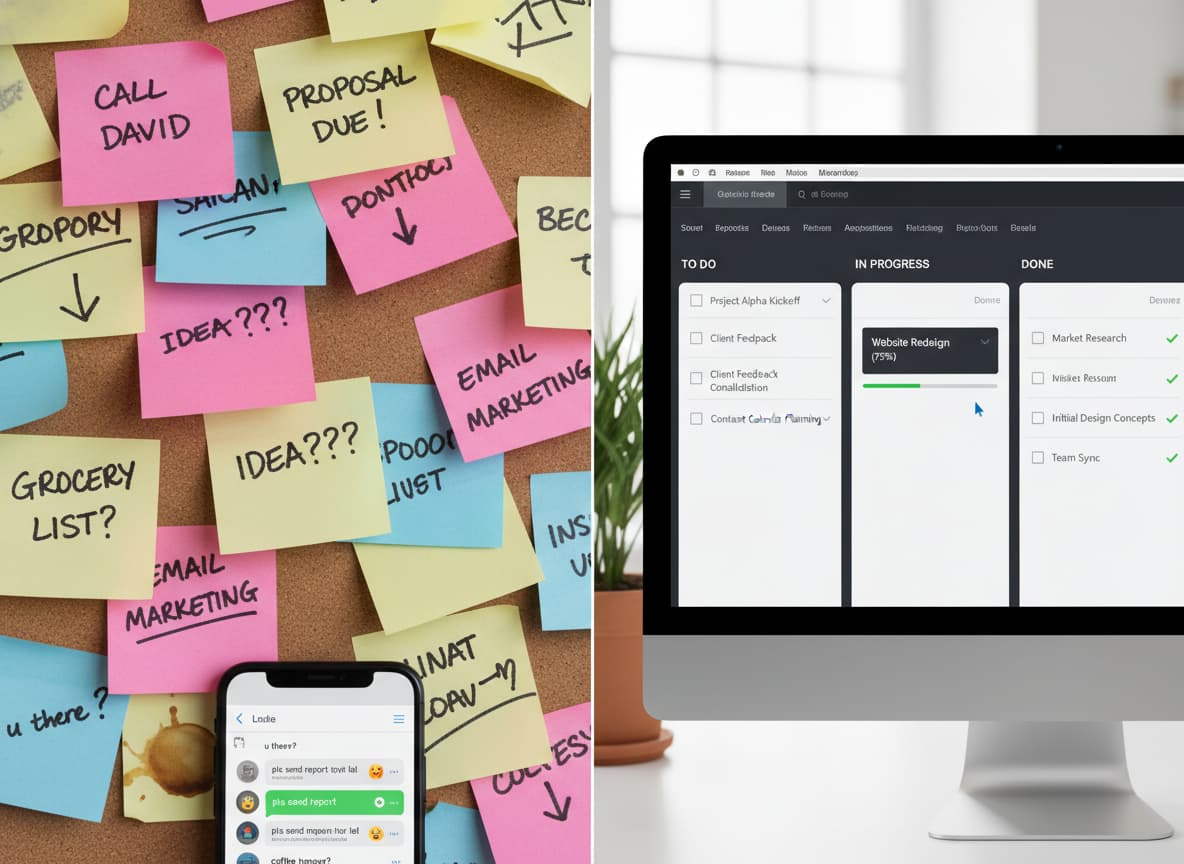
Writing task lists on your dashboard or pinning reminders to a wall might work with a two-person team. But what happens when you have five or more people? Or when jobs run for weeks, not hours?
Sticky notes:
- Get lost or damaged
- Can’t notify anyone
- Don’t track progress
- Don’t show history
They’re a visual crutch, not a reliable system.
2. How Group Chats Cause Confusion, Not Clarity
Group chats feel fast. But they quickly turn into a stream of scattered updates, lost instructions, and untracked decisions.
You’ve probably seen it:
- “Didn’t you see my message?”
- “Which site are we going to?”
- “Who was supposed to bring the tools?”
Important info gets buried. Accountability disappears. And now, you’re micromanaging just to keep the job on track.
Sticky Notes and Chats vs Work Management System
Sticky notes and group chats feel convenient because they are fast. The problem is that they were never built to manage real work across a growing team. Once jobs, deadlines, customers, files, and field updates start moving at the same time, scattered tools create gaps.
A work management system gives your team one place to see what needs to be done, who owns each task, and what has already been completed.
| Work Area | Sticky Notes and Group Chats | Work Management System |
|---|---|---|
| Task ownership | Tasks get mentioned, but ownership is often unclear. | Each task has an assigned person, deadline, and status. |
| Job updates | Updates get buried in message threads or lost on paper. | Updates stay attached to the job, task, or project record. |
| Visibility | Managers need to ask around to know what is happening. | Teams see job progress, task status, and next steps in one place. |
| Accountability | People forget, miss messages, or assume someone else handled it. | Responsibility is documented and easier to follow up on. |
| Files and notes | Photos, notes, and instructions are scattered across devices and chats. | Files, notes, and updates stay connected to the work. |
| Growth | The system breaks as more jobs, people, and deadlines are added. | The system scales with more jobs, users, and workflows. |
3. No Visibility Means More Mistakes
When you’re managing work across multiple people, you need visibility who’s doing what, when, and where.
Sticky notes can’t show you that. Group chats won’t organize it for you. Without a shared, structured dashboard, things fall through the cracks. Deadlines are missed. Clients get frustrated. And your profits take a hit.
4. How Lack of Systems Keeps You in Reaction Mode
Without a central system, every problem becomes urgent. You’re constantly reacting, not planning.
A work management tool lets you:
- Assign tasks with deadlines
- See progress across jobs
- Track job notes, files, and updates
- Keep everyone on the same page
Instead of chasing updates, you’re managing the whole flow from one place.
5. You Can’t Improve What You Don’t Measure
Want to grow? You need data.
Sticky notes and chats leave no trail. You can’t measure performance, repeat success, or spot what’s slowing you down. A work management system gives you the history and reporting that help you improve without guesswork.
Stop Juggling Tasks: Use a Work Management System
Sticky notes are for reminders. Group chats are for quick updates. But if you’re serious about running a business, not just juggling tasks, they’re not enough. A work management system turns scattered communication into real coordination. It gives your crew structure, keeps jobs moving, and saves you from being the middleman every day.
At MyBusinessPortal.cloud, our work management tool is built for real-world contracting teams. It connects with your Hr, CRM and calendar, giving you a complete picture of every job from quote to completion, all in one place.
Signs Your Team Has Outgrown Sticky Notes and Group Chats
Your team may need a work management system if daily work depends on reminders, repeated follow-ups, and scattered updates. The more your team grows, the harder it becomes to manage jobs without a central system.
- Tasks keep getting missed or delayed.
- Important job updates get buried in group chats.
- No one knows who owns the next step.
- Managers spend too much time chasing status updates.
- Files, photos, and notes are hard to find later.
- Clients ask for updates your team cannot answer quickly.
- Completed work is hard to track from assignment to billing.
Stop Managing Work Through Scattered Notes and Chats
MBP Work Management helps your team assign tasks, track job progress, organize updates, and keep everyone accountable from one place.
If your team is tired of chasing messages, checking sticky notes, and asking who is handling what, it may be time to move to a real work management system.
Explore MBP Work ManagementWork Management FAQs
What is the best replacement for sticky notes and group chats at work?
The best replacement is a work management system that tracks tasks, deadlines, updates, files, and team responsibilities in one shared place. This gives your team more structure than notes and more visibility than group chats.
Why do sticky notes fail for team task management?
Sticky notes fail because they do not assign ownership, send reminders, show progress, or keep a history of completed work. They may help with personal reminders, but they are not reliable for managing team workflows.
Why are group chats bad for managing work?
Group chats are useful for quick communication, but they bury important updates inside long message threads. Without task tracking, ownership, and deadlines, work can easily get missed.
When should a business switch to a work management system?
A business should switch when tasks are missed, updates are scattered, managers chase people for progress, or job details are hard to find. These are signs that the team needs a central place to manage work.
How does work management software improve accountability?
Work management software improves accountability by showing who owns each task, when it is due, what status it is in, and what updates have been made. This reduces confusion and makes follow-up easier.