
If you run a small contracting business with five, seven, or even nine employees, you might think HR systems are for “bigger companies.”
They’re not.
In fact, the smaller your team, the more expensive mistakes become. One payroll error. One missed certification renewal. One scheduling conflict. One unclear job role.
When you only have a handful of people, every issue hits harder.
Digital HR is not about corporate bureaucracy. It is about control, clarity, and protecting your business while you grow.
Quick Answer
Why do small contractors need digital HR systems?
Small contractors need digital HR systems to manage payroll, employee records, scheduling, certifications, and time tracking without relying on spreadsheets or memory. As teams grow, manual processes create costly mistakes, scheduling conflicts, and compliance risks. Digital HR systems centralize employee data, improve accountability, and help contractors scale operations with better organization and visibility.
What Happens When Contractors Manage HR With Spreadsheets and Memory
Many small contractors delay investing in HR systems because their team is still small. The problem is that payroll, scheduling, certifications, employee records, and compliance become harder to manage as job volume increases. When information lives in spreadsheets, group chats, and memory, mistakes become more frequent. A digital HR system creates one source of truth that helps contractors stay organized and scale without chaos.
Let’s break this down.
1. Why Small Contractor Teams Face Major HR Risks
Even with fewer than 10 employees, you are still responsible for:
- Payroll accuracy
- Time tracking
- Overtime compliance
- Employee records
- Contracts and documentation
- Leave management
- Certifications and licenses
One missing document or miscalculated paycheck can create serious problems.
Manual spreadsheets and paper folders might work at the start. But once jobs increase, those systems become fragile. You start relying on memory. Then things slip.
A digital HR system keeps everything centralized:
- Employee profiles
- Role definitions
- Pay structure
- Documents
- Performance notes
- Time logs
No guessing. No digging through messages.
Just organized data.
2. How One Bad Hire Affects Small Contractor Businesses
In a large company, one weak hire might go unnoticed.
In a small contractor business, one weak hire affects:
- Job quality
- Customer satisfaction
- Team morale
- Profit margins
Digital HR helps you:
- Track applicant details
- Store interview notes
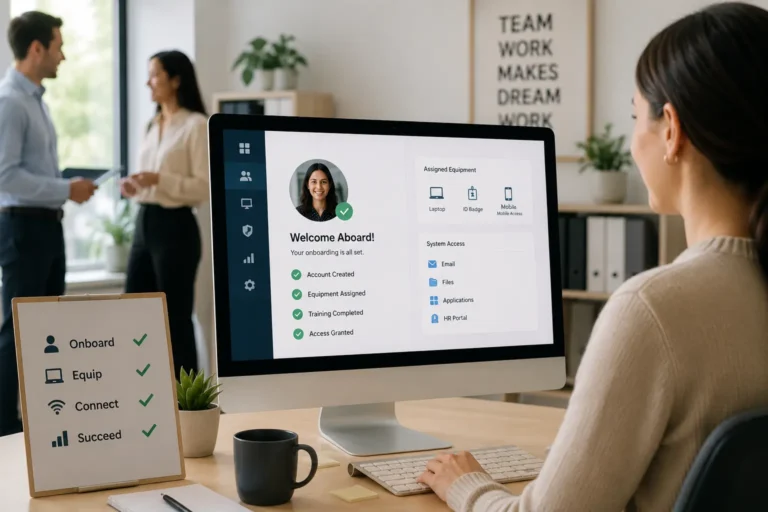
- Standardize onboarding
- Document performance early
When HR connects with your CRM and work management system, you see the full picture:
- Which technician handles which type of client
- Who finishes jobs on time
- Who causes repeat service calls
- Who generates positive feedback
Now hiring becomes data-driven instead of emotional.
3. Why HR Problems Often Cause Scheduling Conflicts
Small contractors often think scheduling is just a calendar issue.
But most scheduling chaos is actually an HR problem.
Examples:
- You double-book a technician.
- Someone forgets to file leave.
- A new hire does not know responsibilities.
- Overtime hours go unnoticed.
When HR is digital and connected to your calendar and work management system:
- Approved leave blocks out automatically.
- Technician availability updates in real time.
- Job assignments match skill levels.
- Overtime becomes visible before it becomes costly.
Now your calendar reflects reality.
Not assumptions.
4. How Payroll Mistakes Hurt Employee Trust
In small teams, payroll mistakes feel personal.
If someone is underpaid even once, trust drops immediately.
Digital HR:
- Tracks hours accurately.
- Connects with job data from your work management system.
- Calculates overtime automatically.
- Stores payment history.
No more manual recalculations every week.
And when payroll is clean, your team focuses on work instead of questioning numbers.
5. Why Proper HR Documentation Protects Contractors
Even if you only have 3 to 8 employees, you are still exposed to:
- Labor disputes
- Wrongful termination claims
- Pay disputes
- Safety violations
Without documentation, it becomes your word against theirs.
Digital HR keeps:
- Signed contracts
- Warning records
- Performance logs
- Attendance history
- Policy acknowledgments
This protection matters more than you think.
6. Why Manual HR Systems Fail as Contractors Grow
Most contractors start small.
Then referrals increase.
Then projects expand.
Then you hire two more people.
Then three.
If you wait to “organize HR later,” you will rebuild everything from scratch.
A digital HR system scales with you.
When integrated with your CRM, calendar, and work management tools:
- New employees connect instantly to job assignments.
- Their schedules sync automatically.
- Their performance ties to real job outcomes.
- Client records in your CRM reflect who handled what.
Everything works together.
Not in silos.
7. How Organized Teams Build Client Confidence
Larger clients look at more than price.
They evaluate:
- Process
- Reliability
- Documentation
- Communication
When your business runs on integrated systems:
- CRM manages client history.
- Work management tracks job progress.
- Calendar organizes crew schedules.
- HR manages team structure and accountability.
You operate like a company with 50 employees, even if you only have 6.
That perception builds trust.
How Digital HR Improves Workforce Control and Visibility
It is an operational discipline.
Small contractors often say:
“We’re too small for HR software.”
The reality:
You are too small to afford disorganization.
When HR connects with your CRM, calendar, and work management system, you stop reacting to problems and start preventing them.
That is the shift.
And that shift separates contractors who stay small from contractors who scale confidently.
If you want structure without complexity, MyBusinessPortal.Cloud brings CRM, scheduling, work management, and HR together in one platform built specifically for trades and field service teams.
Because even with fewer than 10 employees, your business deserves systems that work like a larger operation.
And growth favors the organized.
Why Small Contractors Need Connected HR Systems
If you rely on spreadsheets, group chats, and memory to manage your employees, you are one disruption away from confusion.
MyBusinessPortal.Cloud connects:
• HR
• CRM
• Live scheduling
• Work management
All in one platform built for contractors.
Digital HR Software FAQs for Contractors
Why do small contractors need digital HR systems?
Small contractors need digital HR systems to manage payroll, scheduling, employee records, certifications, and time tracking without relying on spreadsheets or memory. Manual processes create costly mistakes, compliance risks, and scheduling conflicts as teams grow. Digital HR centralizes information and improves visibility across the business.
What HR problems do small contractor businesses commonly face?
Small contractor businesses often struggle with payroll errors, overtime tracking, missing certifications, scheduling conflicts, and disorganized employee records. Because smaller teams rely heavily on every employee, even one mistake can disrupt operations, reduce productivity, and damage trust within the team.
How does digital HR improve scheduling and team management?
Digital HR systems connect employee availability, leave requests, certifications, and schedules into one platform. This helps prevent double bookings, overtime issues, and assigning the wrong technician to a job. When HR integrates with work management and calendar systems, scheduling reflects real-time team availability instead of assumptions.
Why are payroll mistakes dangerous for small teams?
Payroll mistakes damage employee trust quickly, especially in small businesses where teams work closely together. Digital HR systems help by accurately tracking hours, calculating overtime automatically, and storing payment history in one place. This reduces manual errors and creates more transparency between employees and management.