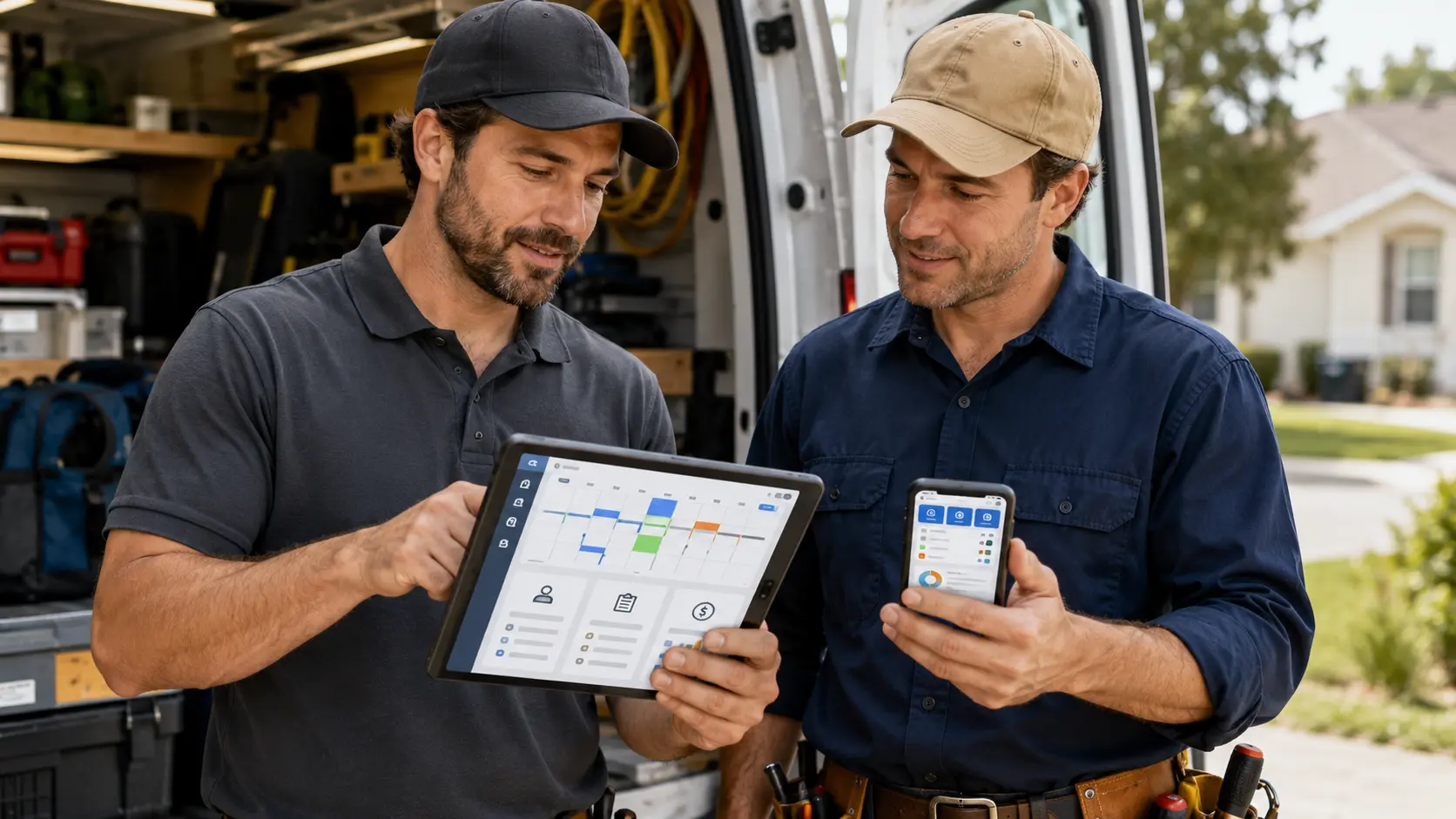
Choosing field service software is a major decision for small contractors. Jobber and Housecall Pro are two popular platforms, but they are built differently and may fit different business needs.
Some contractors need simple scheduling, estimates, invoicing, and customer communication. Others need a more complete operating system that connects CRM, HR, inventory, accounting, work management, and daily operations.
This Jobber vs Housecall Pro comparison explains the strengths, limitations, and differences between both platforms so contractors can choose the right solution for their workflow.
Quick Answer
Is Jobber or Housecall Pro better for small contractors?
Jobber and Housecall Pro are both strong field service platforms for scheduling, estimates, invoicing, and customer management. The better choice depends on business size, workflow needs, and required features.
Contractors looking for broader operations management may prefer an all-in-one platform like MBP that connects CRM, HR, Inventory, Work Management, Accounting, and Calendar tools.
Why This Comparison Matters for Small Contractors
Small contractors do not have room for software that looks good in a demo but slows the team down in real life. A contractor may only have a few office staff, several technicians, and a packed schedule. If a platform is too complicated, too expensive, or too disconnected from daily operations, it becomes another thing to manage.
That is the trap.
Field service software should help contractors reduce missed jobs, avoid double booking, speed up invoicing, track customer details, manage teams, and stay ahead of follow-ups. It should not force the owner to spend nights cleaning up records or teaching the crew how to use confusing tools.
When comparing Jobber and Housecall Pro, small contractors should focus on practical questions:
- Can the team learn it quickly?
- Can field workers use it from their phones?
- Does it make scheduling easier?
- Does it reduce admin work?
- Does pricing still make sense as the team grows?
- Does it help win and manage customers?
- Does it connect with the tools the business already uses?
- Does it fit the contractor’s workflow, not just the software company’s sales pitch?
Jobber vs Housecall Pro at a Glance
| Category | Jobber | Housecall Pro | What Small Contractors Should Check |
| Best fit | Small service teams that want simple job management | Home service teams that want scheduling, dispatching, and growth tools | Choose based on team size, workflow, and future growth |
| Core strengths | Scheduling, quoting, invoicing, payments, client communication | Dispatching, scheduling, customer communication, payment tools, business growth features | Test the daily workflow before committing |
| Field use | Strong mobile-first job access for technicians | Strong field app experience for home service pros | Make sure field workers can update jobs easily |
| Pricing | Entry-level plans can be attractive for smaller teams | Starts higher but includes tools aimed at growing service businesses | Look beyond the starting price |
| Scalability | Works well for solo operators and small crews | Built for growing home service companies | Compare user limits, add-ons, and upgrade costs |
| Marketing | Helps with customer communication and review workflows | Often positioned with stronger customer acquisition and marketing support | Check what is included vs added later |
| Integrations | Works with common business tools such as accounting and payments | Offers integrations for field service operations and business management | Confirm your required tools connect properly |
| Alternative option | MBP can support contractors that need simpler connected admin across scheduling, CRM, tasks, and operations | MBP can support teams that want an easier centralized business portal | Consider total workflow fit, not brand popularity |
Pricing & Scalability
Pricing & Scalability should be one of the first things small contractors review. A low starting price can look attractive, but the real cost depends on team size, users, features, add-ons, payment tools, and future growth.
Small contractors should not only ask, “What does it cost today?” They should ask, “What will this cost when we add another crew, another admin person, or another location?”
Jobber
Jobber is known for offering entry-level plans that can appeal to solo contractors and smaller teams. It is often a practical starting point for businesses that need to move from paper, whiteboards, and spreadsheets into a more organized field service system.
For contractors with simple workflows, Jobber can cover the basics well. Scheduling, quoting, invoicing, customer records, and payment collection are all important features for daily service operations.
The key thing to watch is how pricing changes as the business grows. A contractor may start with a basic plan, then later need more users, better automation, reporting, customer communication, or advanced workflow features. That can change the true monthly cost.
Jobber may be a good fit if your team wants a clean system for managing jobs without immediately needing a heavy operations platform.
Housecall Pro
Housecall Pro is also built for home service businesses and small contractors, but it often feels positioned for companies that want a broader operating platform. It includes tools for scheduling, dispatching, invoicing, customer communication, payments, and business growth.
For contractors planning to grow, Housecall Pro may offer features that support more active dispatching, customer management, and team coordination. However, the same pricing caution applies. The starting plan may not include every feature a growing contractor eventually needs.
Small contractors should compare plan limits carefully. The best plan is not always the cheapest one. It is the plan that includes the tools your business actually needs without forcing you into expensive upgrades too quickly.
Jobber vs Housecall Pro Feature Comparison
| Feature | Jobber | Housecall Pro |
|---|---|---|
| Scheduling | ✓ | ✓ |
| Estimates | ✓ | ✓ |
| Invoicing | ✓ | ✓ |
| Customer management | ✓ | ✓ |
| Online payments | ✓ | ✓ |
| Mobile app | ✓ | ✓ |
| Marketing tools | Limited | Strong |
| Team management | ✓ | ✓ |
| Inventory management | Limited | Limited |
| Full business operations | Limited | Limited |
User Experience & Field Use
User Experience & Field Use can make or break field service software. Office staff may like a dashboard, but if field workers hate using the mobile app, the system fails fast.
Contractors need software that works during real job conditions. Crews may be in trucks, on job sites, in basements, on roofs, or between appointments. They need quick access to job details, customer notes, schedules, photos, forms, and payment options.
Jobber
Jobber is often praised for being simple and approachable. For small teams, that matters. A clean interface can reduce training time and help employees adopt the system faster.
In the field, Jobber can help technicians view job details, check schedules, update work status, collect payments, and communicate with customers. This can reduce the need for constant phone calls between field staff and the office.
Jobber may be especially useful for contractors who want a straightforward system that does not overwhelm employees with too many screens or complicated workflows.
The possible downside is that some growing teams may eventually want deeper customization, reporting, or operational controls. That does not mean Jobber is weak. It means contractors should think ahead before choosing any platform.
Housecall Pro
Housecall Pro also focuses heavily on field use. It is designed for home service pros who need scheduling, dispatching, job updates, customer communication, and payment collection from the field.
For teams with several technicians or more active dispatch needs, Housecall Pro may feel strong because it is built around service calls and customer-facing workflows. The platform can support a more complete field service process from booking to completion.
However, more features can also mean more setup, training, and decision-making. Small contractors should test whether the platform feels helpful or heavy for their specific team.
A platform can be powerful and still be the wrong fit if employees avoid using it.
Marketing & Customer Acquisition
Marketing & Customer Acquisition matter because contractors do not only need to complete jobs. They also need to win jobs, follow up with leads, collect reviews, and keep customers coming back.
A good field service system should help prevent leads from slipping through the cracks.
Jobber
Jobber offers customer communication tools that can help contractors manage client relationships, send quotes, follow up, and create a more professional customer experience. For many small contractors, this is already a major upgrade from scattered text messages and manual reminders.
Jobber can help keep customer details organized so teams know who was contacted, what work was quoted, what jobs were completed, and what payments are pending.
For small contractors, that kind of visibility can support repeat business and better customer service.
The main question is whether Jobber’s marketing tools are enough for your growth goals. If your business depends heavily on campaigns, lead tracking, advanced customer acquisition, or deeper marketing automation, compare features carefully.
Housecall Pro
Housecall Pro is often viewed as strong in customer communication and growth-focused workflows. It can help service businesses manage the customer journey from booking to payment, including follow-ups and review-related activities.
For contractors that want more help with customer acquisition and ongoing communication, Housecall Pro may be attractive. It can support a more polished customer experience and help businesses look more professional from the first contact.
Still, contractors should avoid paying for growth tools they do not use. Fancy marketing features are only valuable if they fit the business process and someone on the team actually manages them.
Integrations & Alternatives
Integrations & Alternatives should be reviewed before signing up for any platform. Software does not work alone. Contractors usually rely on accounting software, payment processors, email, calendars, customer records, payroll tools, reporting systems, or inventory tracking.
If the platform does not connect with your current tools, your team may end up doing duplicate admin work.
That defeats the whole point.
Jobber and Housecall Pro both offer integrations with common business tools. Before choosing either one, contractors should list the systems they already use and confirm which integrations are included, which require higher plans, and which need extra setup.
Important integrations to check include:
- Accounting software
- Payment processing
- Calendar tools
- Email and SMS communication
- Lead sources
- Customer relationship management tools
- Reporting tools
- Inventory or equipment tracking
- Payroll or time tracking systems
Small contractors should also consider alternatives if they do not need a full field service platform. Some businesses need a simpler connected system for scheduling, tasks, CRM, documents, employee records, and day-to-day operations.
That is where MBP can be a practical option.
What Small Contractors Actually Need in 2026
Small contractors in 2026 need more than basic scheduling. They need software that helps them control the daily chaos of running jobs, managing employees, following up with customers, and keeping work moving.
The best system should help with:
- Scheduling jobs clearly
- Assigning work to the right people
- Tracking job status
- Managing customer details
- Sending quotes and invoices
- Collecting payments faster
- Preventing missed follow-ups
- Keeping documents organized
- Reducing manual admin
- Improving communication between office and field teams
- Giving managers better visibility
The real goal is not just software adoption. The goal is fewer missed details, fewer delays, less admin stress, and better customer service.
When Jobber May Be the Better Fit
Jobber may be the better fit for contractors who want a simple, clean, and easy-to-use field service platform. It can work well for solo contractors, small teams, and businesses that want to organize scheduling, quoting, invoicing, payments, and customer records without overcomplicating the process.
Jobber may be a good choice if:
- Your team wants a simple interface
- You need better scheduling and invoicing
- You want to move away from paper or spreadsheets
- Your field workers need easy mobile access
- You do not need a heavy operations platform
- You want a system that is easier to adopt quickly
For many small contractors, simplicity is a feature. If the crew actually uses the software, the business gets better data and fewer surprises.
When Housecall Pro May Be the Better Fit
Housecall Pro may be the better fit for contractors who want a broader home service platform with strong scheduling, dispatching, customer communication, and growth-focused tools.
Housecall Pro may be a good choice if:
- Your business has active dispatch needs
- You want a field service platform built for home service pros
- You need strong customer communication tools
- You want support for growth and repeat customers
- You need a system that can support a larger team
- You are willing to spend more time comparing plan features
Housecall Pro can be a strong option for businesses that want more than basic job tracking. The key is making sure the added features are worth the cost and setup effort.
Where MBP Fits as an Alternative
Jobber and Housecall Pro are both strong names in field service software, but not every contractor needs the same kind of platform.
Some small businesses need a more centralized way to manage work across scheduling, CRM, tasks, employee information, documents, and daily operations. They may not want separate tools for every department or a system that becomes too complex for the team.
My Business Portal helps small businesses organize the moving parts of daily work in one connected platform. For contractors, that can mean better visibility across jobs, customers, tasks, schedules, admin, and team activity.
MBP may be useful for contractors that want to:
- Reduce scattered admin
- Centralize customer and job information
- Improve team visibility
- Keep tasks and schedules organized
- Support office and field coordination
- Make business operations easier to manage
- Avoid relying on disconnected spreadsheets and message threads
The best software is the one that fits how your business actually runs. For some contractors, that may be Jobber. For others, it may be Housecall Pro. For teams that want simpler connected business management, MBP may be the better path.
Which Software Fits Your Business?
| Business Type | Better Fit |
|---|---|
| Solo contractor | Jobber or Housecall Pro |
| Small service team | Both options work |
| Growing contractor | Look beyond basic FSM tools |
| Multiple departments | All-in-one platform |
| Needs HR and inventory | MBP-style platform |
Which Offers Better Value?
The cheapest software is not always the best value. Contractors should compare:
- Number of users needed
- Required features
- Additional add-ons
- Integrations
- Administrative time saved
- Ability to scale
A platform that solves only scheduling may require additional software later for HR, inventory, accounting, or reporting.
Looking Beyond Jobber and Housecall Pro
Jobber and Housecall Pro are designed primarily for field service management. However, growing contractors often need more than scheduling and invoicing.
An all-in-one platform like MBP helps businesses connect:
- CRM for leads and customers
- Work Management for tasks and workflows
- HR for employee records
- Inventory for tools and materials
- Accounting for financial tracking
- Calendar for scheduling
This reduces the need to manage multiple disconnected systems.
Final Verdict: Compare Workflow Before Brand Name
Jobber vs Housecall Pro is not just a software comparison. It is a business management decision.
Jobber may be better for contractors that want simplicity, fast adoption, and clean job management. Housecall Pro may be better for contractors that want a broader field service management platform with stronger dispatching, customer communication, and growth tools. MBP may be better for businesses that want centralized operations, CRM, scheduling, task management, employee records, and workflow visibility without overloading the team with tools they do not need.
Before choosing, small contractors should review pricing, scalability, user experience, field use, marketing tools, CRM features, integrations, and alternatives. They should also test each platform with real contractor workflows, not just demo examples.
In 2026, small contractors do not need business software that only looks impressive on a sales page. They need contractor software that helps them schedule faster, manage customer relationships, communicate better, reduce admin, support the field team, and protect profit.
COMPARE YOUR OPTIONS
Choose Software That Supports Your Entire Business
MBP helps contractors go beyond scheduling by connecting customers, employees, inventory, work, accounting, and operations in one platform.
Schedule a DemoRelated Contractor Software Comparisons
- Jobber Alternatives for Contractors
- Best Field Service Management Software for Small Contractors
- Contractor CRM Guide
- Connect Contractor CRM With Scheduling and Work Orders
Frequently Asked Questions
Is Jobber better than Housecall Pro for small contractors?
Jobber may be better for small contractors that want simple scheduling, quoting, invoicing, payments, and an easy mobile experience. Housecall Pro may be better for contractors that want broader dispatching, customer communication, and growth tools. The better choice depends on team size, workflow, pricing, and feature needs.
Is Housecall Pro worth it for small service businesses?
Housecall Pro can be worth it for small service businesses that need strong scheduling, dispatching, customer communication, and payment tools. However, contractors should compare plan costs and included features before deciding.
What should contractors compare before choosing field service software?
Contractors should compare pricing, user limits, mobile app usability, scheduling tools, invoicing, customer communication, marketing features, integrations, reporting, and scalability. They should also test how well the software fits their real daily workflow.
Does Jobber help with customer management?
Yes. Jobber includes customer management tools that help contractors store client details, manage quotes, track jobs, send invoices, and communicate with customers more professionally.
Does Housecall Pro help with marketing?
Housecall Pro includes customer communication and growth-focused tools that can support marketing and customer acquisition. Contractors should check which marketing features are included in each plan before choosing.
What is a good alternative to Jobber and Housecall Pro?
MBP can be a good alternative for small contractors that want centralized business management across scheduling, CRM, tasks, documents, employee information, and operations. It can help reduce scattered admin and improve team visibility.