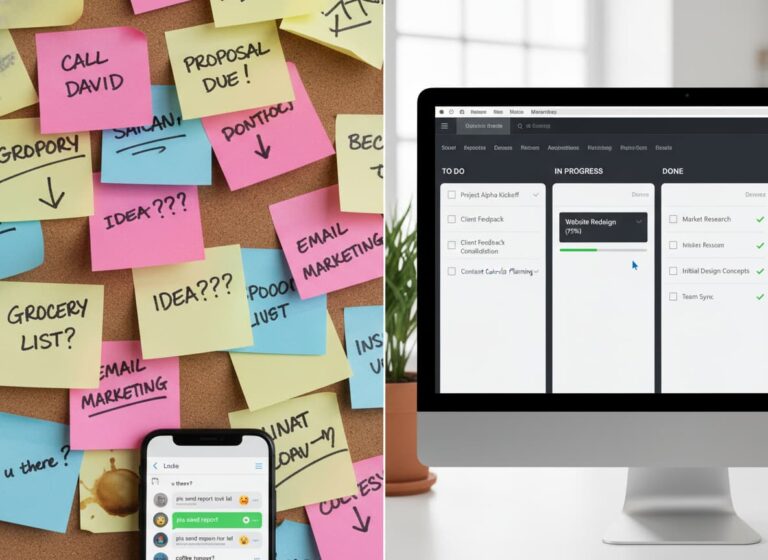
Work management tools drive business growth by turning daily tasks into organized, trackable systems that reduce chaos and free up time for higher-value work. For small service businesses and contracting teams, days fill up fast with job requests, crew coordination, material runs, client calls, and last-minute schedule changes. Staying busy feels productive, but without a system behind those tasks, progress stalls. When work lives in scattered notes, messages, and memory, teams spend their energy reacting instead of building capacity. This is why structured work management becomes essential for moving from constant firefighting to sustainable growth.
Quick Answer
How do work management tools turn daily tasks into business growth?
Work management tools turn daily tasks into business growth by organizing jobs, responsibilities, deadlines, updates, and team activity in one centralized system.
When daily work becomes easier to track and repeat, businesses reduce chaos, improve accountability, save time, and create more room for growth. Teams can focus less on managing tasks manually and more on improving operations, serving customers, and scaling the business.
How Work Management Tools Support Business Growth
| Daily Task Problem | Work Management Fix | Growth Benefit |
|---|---|---|
| Tasks are scattered across texts, calls, and notes | Centralize tasks, job details, updates, and ownership in one system. | Teams spend less time searching for information and more time completing work. |
| No clear task ownership | Assign each task to a specific person with deadlines and status updates. | Accountability improves and fewer jobs fall through the cracks. |
| Managers chase updates all day | Use shared visibility to track job progress and incomplete work. | Managers can make faster decisions and focus on higher-value work. |
| Processes change from job to job | Create repeatable workflows for common jobs, approvals, and follow-ups. | The business becomes easier to scale because work is more consistent. |
| Scheduling and tasks are disconnected | Connect work management with calendar visibility and job scheduling. | Teams can plan capacity, avoid conflicts, and reduce last-minute chaos. |
| Customer context is missing | Connect daily tasks with CRM details, notes, and customer history. | Customer service improves and repeat business becomes easier to manage. |
Why Most Businesses Stay Stuck in “Survival Mode”
When your day is filled with tasks but there’s no system to organize them, you end up:
- Repeating the same decisions every day
- Wasting time chasing information
- Reacting to problems instead of preventing them
- Missing deadlines or redoing work
- Relying on memory or manual checklists
You’re constantly moving but you’re not moving forward.
Without structure, small problems become big bottlenecks. And when things go wrong, your growth stalls because you’re too busy catching up to even think about expanding.
Manual Task Management vs Work Management Software
| Manual Task Management | Work Management Software |
|---|---|
| Tasks tracked through memory, emails, or spreadsheets | Tasks organized in one centralized system |
| Managers chase updates manually | Progress is visible in real time |
| Responsibilities can become unclear | Each task has ownership and deadlines |
| Processes change from person to person | Workflows can be standardized |
| Difficult to measure productivity | Reports show workload and progress |
What Work Management Tools Actually Do
A work management system helps you move from reactive to proactive. It turns your team’s daily activities into a consistent, trackable, and efficient process.
Here’s how:
- Centralizes all your tasks in one place
You can assign, monitor, and update jobs without digging through chats or spreadsheets. - Breaks down complex jobs into actionable steps
Instead of saying “Finish the install,” you can track who’s doing what, and by when. - Keeps your team aligned
When everyone knows their responsibilities and deadlines, jobs get done faster with fewer mistakes. - Reveals patterns
You’ll see where delays happen, which crews are overbooked, and what tasks are repeatedly causing slowdowns. Work management software also helps businesses identify: - recurring workflow bottlenecks
- delayed projects
- overloaded employees
- missed deadlines
- inefficient processes
- Frees up your time
Once your day-to-day runs on a system, you can shift focus to marketing, sales, hiring, or growth planning.
Even if you start small by just organizing your jobs for the week, the impact can be immediate.
The Power of Compounding Efficiency
Think of work management software like laying track for a train. Every task, every process, every team handoff becomes part of a smooth path forward.
When things run smoothly, you waste less time on errors and admin. That time can now be spent quoting new jobs, following up with clients, or training new hires. These are the kinds of tasks that grow your business but only if your base operations are solid.
And over weeks and months, that time savings compounds.
How Daily Task Visibility Creates Long-Term Growth
Daily task visibility creates long-term growth because it helps teams see what is happening before small issues become bigger problems. When tasks, deadlines, job details, and ownership are visible, managers do not have to rely on memory, scattered messages, or end-of-day updates to understand the business.
This visibility helps businesses improve the same small processes again and again. If jobs are delayed because materials are missing, the team can spot the pattern. If certain tasks keep getting reassigned, the business can adjust the workflow. If crews are overloaded on specific days, scheduling can be improved before delays affect customers.
Over time, those small improvements compound. Less rework means more available time. Clearer ownership means fewer missed deadlines. Better job tracking means stronger customer communication. That is how daily task management becomes more than a checklist. It becomes an operating system for growth.
MBP Work Management helps teams organize daily tasks, job updates, responsibilities, and workflow visibility in one place. When connected with Calendar and CRM, businesses can manage schedules, customer details, and daily work from one connected system. For more task visibility support, read how work management improves crew accountability and job visibility. To ask about setup, visit the Contact page.
Turn Daily Tasks Into a System for Growth
MBP Work Management helps teams organize tasks, jobs, schedules, updates, and responsibilities so daily work becomes easier to track, manage, and scale.
Stop relying on scattered messages, spreadsheets, and memory. Build a connected system that improves visibility, accountability, and team productivity as your business grows.
Explore MBP Work Management Contact MBPThe Role of Calendar and CRM in Work Management
While your work management tool handles the day-to-day task execution, tools like a calendar and CRM round out your system.
- A built-in calendar gives you full visibility of jobs by date, crew, and availability, so you’re never double-booked.
- A CRM lets you connect those jobs to clients, quotes, and past work so you always have context when making decisions.
Together, these tools help you run your business like a system, not just a string of tasks.
A connected business management system becomes more powerful when work management connects with other core operations.
CRM helps teams maintain customer information and follow-ups.
Calendar helps businesses manage schedules, deadlines, and availability.
HR helps manage employees, roles, and workforce information.
Inventory helps teams monitor materials, supplies, and operational resources.
Together, these tools create a connected workflow where teams can manage daily tasks while building long-term business growth.
Final Take
You already know how to hustle. But real business growth comes from building systems that work even when you’re not watching every detail.
At MyBusinessPortal.cloud, our work management tools help you take control of your daily operations. With smart job tracking, crew assignments, and status visibility, your team works better, faster, and with fewer mistakes. And with integrated tools like our HR, calendar and CRM, you stay ahead without adding more chaos.
Work Management Tools and Business Growth FAQs
How do work management tools help business growth?
Work management tools help business growth by organizing tasks, job details, deadlines, team responsibilities, and updates so daily work becomes easier to track and improve.
Why do daily tasks affect long-term business growth?
Daily tasks affect long-term business growth because repeated delays, missed updates, unclear ownership, and scattered information can slow down operations over time.
What should small businesses track in work management software?
Small businesses should track task ownership, due dates, job status, customer updates, schedule changes, workload, and incomplete work.
How does work management improve team accountability?
Work management improves team accountability by showing who owns each task, what is due, what is complete, and which jobs need attention.
Can work management connect with Calendar and CRM?
Yes. Work management can connect with Calendar and CRM so schedules, customer details, jobs, and daily tasks stay aligned in one system.
What features should businesses look for in work management software?
Businesses should look for task tracking, workflow automation, team collaboration, scheduling, reporting, progress tracking, and integrations with other business systems.
Can work management software help small businesses scale?
Yes. Work management software helps small businesses scale by creating repeatable workflows, improving visibility, reducing manual work, and making team coordination easier as operations grow.
Why are spreadsheets not enough for growing businesses?
Spreadsheets become difficult to manage when businesses need real-time updates, task ownership, workflow automation, and visibility across multiple projects and teams.